

Guyana Graphic | International Law and Maritime Affairs
Does a State have the right to prevent a foreign vessel from passing through its maritime waters? Although the question appears straightforward, it is among the most frequently misunderstood in international relations. The answer depends on the location of the vessel, the activity in which it is engaged, whether it is a commercial ship or a warship, and which rules of international law apply.
For Guyana, these distinctions carry particular weight. The country has a rapidly expanding offshore petroleum industry, significant Atlantic shipping routes, and a longstanding territorial controversy with Venezuela. Each of these circumstances is shaped by the law of the sea.
The Legal Framework: UNCLOS
The principal source of law is the United Nations Convention on the Law of the Sea (UNCLOS), adopted in 1982 and frequently described as the constitution of the oceans. The Convention establishes maritime boundaries, navigation rights, the allocation of natural resources, environmental obligations, and procedures for settling disputes.
Its central principle is that a State’s authority over the sea varies with the distance from its coastline and the legal classification of the waters concerned.
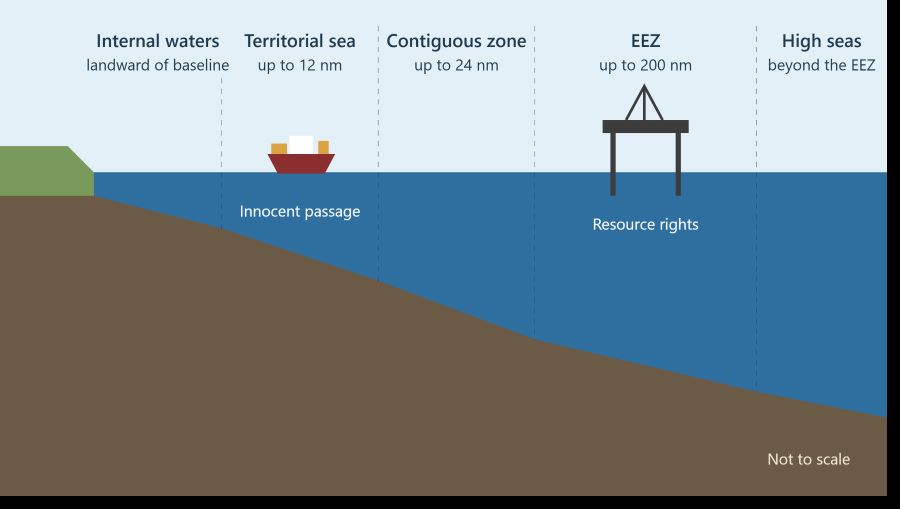
The Five Principal Maritime Zones
- Internal waters lie landward of the baseline and include ports and certain bays and rivers. The coastal State exercises full sovereignty over these waters.
- The territorial sea extends up to 12 nautical miles from the baseline. Coastal State sovereignty applies, subject to the right of innocent passage and other rules of international law.
- The contiguous zone extends up to 24 nautical miles from the baseline. The coastal State possesses limited enforcement powers concerning customs, fiscal, immigration, and sanitary laws.
- The Exclusive Economic Zone (EEZ) extends up to 200 nautical miles. The coastal State holds rights over natural resources, while other States retain freedoms of navigation.
- The high seas comprise all waters beyond national EEZs. Freedom of navigation applies, subject to international law.
Distances are measured from legally established baselines rather than from the visible shoreline, and overlapping maritime claims may require delimitation. (See UNCLOS Articles 2–8, 33, 55–58, and 86–87.)
The Right of Innocent Passage
Article 17 of UNCLOS establishes that ships of all States, including land-locked States, enjoy the right of innocent passage through the territorial sea of another State without prior authorization. This right is, however, conditional.
Article 18 requires that passage be continuous and expeditious. Stopping or anchoring is permitted where it is incidental to ordinary navigation, necessitated by distress or force majeure, or undertaken to assist persons in danger. Article 19 provides that passage must not prejudice the peace, good order, or security of the coastal State. Activities that render passage non-innocent include weapons exercises, intelligence gathering prejudicial to the coastal State’s security, unauthorized fishing, serious pollution, the launching or recovery of aircraft, and interference with communications systems.
Accordingly, a foreign cargo vessel proceeding peacefully along Guyana’s coast may rely on the right of innocent passage, whereas a vessel engaged in unauthorized fishing or military exercises within Guyana’s territorial sea would be in a materially different legal position. The determining factor is the vessel’s conduct, not its nationality or mere presence.
Enforcement Powers of the Coastal State
Coastal States possess significant enforcement powers, but those powers are subject to limits.
Under Article 25, a coastal State may take the steps necessary in its territorial sea to prevent passage that is not innocent. It may also temporarily suspend innocent passage in specified areas where essential for security, provided that the suspension is non-discriminatory and duly published. Article 24, however, prohibits the imposition of requirements that would in effect deny or impair innocent passage.
Article 27 further restricts the exercise of criminal jurisdiction aboard a foreign ship merely transiting the territorial sea. Such jurisdiction may be exercised only where:
- the consequences of the crime extend to the coastal State;
- the crime disturbs the peace of the country or the good order of the territorial sea;
- the master of the ship, or a diplomatic or consular officer of the flag State, requests assistance; or
- such measures are necessary for the suppression of illicit traffic in narcotic drugs.
The practical consequence is that a State may not ordinarily board, detain, or seize a foreign merchant vessel solely because it is transiting the territorial sea. Any enforcement action must rest upon a recognized legal basis and observe the limits prescribed by international law.
The Status of Warships
Warships raise more sensitive questions because they are instruments of national military power. The provisions of UNCLOS on innocent passage apply to ships of all States, including warships. Article 30 nevertheless permits a coastal State to require a warship to leave the territorial sea immediately where the warship fails to comply with the coastal State’s laws and regulations concerning passage and disregards a request for compliance. Article 32 preserves the sovereign immunity of warships, subject to the exceptions and responsibilities set out in the Convention.
States disagree on whether foreign warships must obtain prior authorization or give prior notification before entering a territorial sea. Certain coastal States maintain such requirements, while major maritime powers reject them as inconsistent with the right of innocent passage. It would therefore be inaccurate to assert that every foreign naval vessel requires prior permission. A warship exercising innocent passage must comply with the rules governing that passage, and its military status does not authorize threatening conduct, weapons exercises, or other prohibited activities. Under Article 20, submarines and other underwater vehicles must navigate on the surface and show their flag while exercising innocent passage.
The Exclusive Economic Zone: Economic Rights Distinguished from Sovereignty
The EEZ is frequently misunderstood. Although it may extend up to 200 nautical miles from the baselines, a State does not exercise over it the sovereignty that it holds over its territorial sea.
Under Article 56, the coastal State holds sovereign rights for the purpose of exploring, exploiting, conserving, and managing natural resources, including fisheries, oil, and natural gas. It also has jurisdiction over artificial islands and installations, marine scientific research, and the protection of the marine environment. Article 58 preserves the freedoms of navigation and overflight enjoyed by other States, together with other internationally lawful uses of the sea associated with those freedoms.
For Guyana, this distinction is fundamental. Foreign commercial vessels generally may transit Guyana’s EEZ without seeking authorization. They may not, however, extract Guyana’s petroleum resources, fish without authorization, or disregard lawful safety measures around offshore installations. The presence of a vessel within an EEZ does not, in itself, constitute a violation of the coastal State’s sovereignty.
International Straits and Transit Passage
Certain waterways are of such importance to international navigation that the law affords them additional protection. Under Articles 37–44, straits used for international navigation are governed by the right of transit passage, which generally permits ships and aircraft to proceed continuously and expeditiously between areas of the high seas or EEZs. Unlike innocent passage, transit passage may not be suspended by the States bordering the strait. Vessels remain bound by applicable obligations concerning navigation, safety, and the prevention of pollution. Not every strait falls within this regime, and UNCLOS provides exceptions and alternative rules for particular geographical circumstances.
The High Seas
Beyond national EEZs, navigation on the high seas is governed by the principle of freedom. Article 87 recognizes freedoms that include navigation, overflight, fishing (subject to conservation obligations), and the laying of submarine cables and pipelines. Under Article 92, vessels are generally subject to the exclusive jurisdiction of their flag State, save in exceptional cases provided for in treaties or international law.
Those exceptions are significant. Article 110 recognizes a limited right of visit by warships where there are reasonable grounds for suspecting piracy, the slave trade, unauthorized broadcasting, statelessness, or certain cases of concealed common nationality. Article 111 permits hot pursuit where its detailed conditions are satisfied. The high seas are therefore not lawless; enforcement responsibilities are distributed among flag States and other States possessing specific legal authority.
Guyana, Venezuela, and the Significance of Maritime Law
These principles carry direct economic and security implications for Guyana. The offshore petroleum industry depends on predictable navigation, secure installations, and the exercise of internationally recognized rights over seabed resources.
The controversy with Venezuela adds a further dimension. The International Court of Justice is considering the dispute concerning the validity and binding effect of the 1899 Arbitral Award establishing the boundary between British Guiana and Venezuela. In May 2025, the Court reaffirmed its earlier provisional measures and directed Venezuela to refrain from holding or preparing elections in the disputed territory, which Guyana currently administers and controls. Those proceedings concern the territorial dispute and should not be mistaken for a final judicial determination of every maritime boundary or navigation question between the two States.
Any maritime incident involving Guyana or Venezuela therefore requires careful examination of several questions. Where precisely was the vessel located: in a territorial sea, in an EEZ, or in an area of overlapping claims? Was it merely navigating, or was it engaged in resource exploration, fishing, or military operations? Was it a commercial vessel, a government ship, or a warship? The answers determine which rules apply and what action the coastal State may lawfully take.
International law does not permit a State to convert every disputed maritime area into a zone from which foreign navigation is automatically excluded. Equally, freedom of navigation cannot serve as a general justification for violating another State’s lawful resource rights or threatening its security.
The Responsibilities of Flag States
International law also imposes obligations on the State whose flag a vessel flies. Article 94 requires flag States to exercise effective jurisdiction and control over ships flying their flag in administrative, technical, and social matters, including measures concerning safety, seaworthiness, crew qualifications, and compliance with relevant international regulations. This explains why a vessel’s registration is significant, and why its ownership, operator, registration, and activities must be established before any legal conclusion is drawn about a maritime incident.
Implications for Guyana’s Future
Guyana’s economic development will increase the importance of maritime governance. Commercial shipping, offshore petroleum production, fisheries, maritime security, and foreign investment all depend upon a stable legal environment. Guyana must protect its territorial integrity and natural resources while respecting the navigation rights guaranteed to other States. This requires investment in maritime surveillance, hydrographic information, coast guard capabilities, legal expertise, and diplomatic engagement, together with a well-informed public.
When a foreign vessel enters waters associated with Guyana, the appropriate initial inquiry is not whether the vessel is foreign, but whether its location and conduct contravene a specific rule of international law. Maintaining that distinction is essential for a country whose future is closely connected to the Atlantic Ocean.
International maritime law confers both protection and responsibility. It grants coastal States important rights over their waters and resources while preserving the navigation freedoms essential to global trade. Guyana’s long-term interests are best served by defending its lawful maritime rights consistently, respecting the corresponding rights of other States, and insisting that disputes be resolved through established legal processes rather than by threats or unilateral force.
Sources and Legal References
- United Nations, United Nations Convention on the Law of the Sea (complete treaty).
- United Nations, UNCLOS Part II: Territorial Sea and Contiguous Zone, Articles 2–33.
- United Nations, UNCLOS Part III: Straits Used for International Navigation, Articles 34–45.
- United Nations, UNCLOS official table of contents (EEZ, high seas, and dispute-settlement provisions).
- International Court of Justice, Guyana v. Venezuela, Order of 1 May 2025 (provisional measures).
Editorial classification: International Law / Maritime Affairs. This analysis is based on UNCLOS and the cited judicial materials. Rules applicable to non-parties to UNCLOS may also depend on customary international law and other treaties.





)