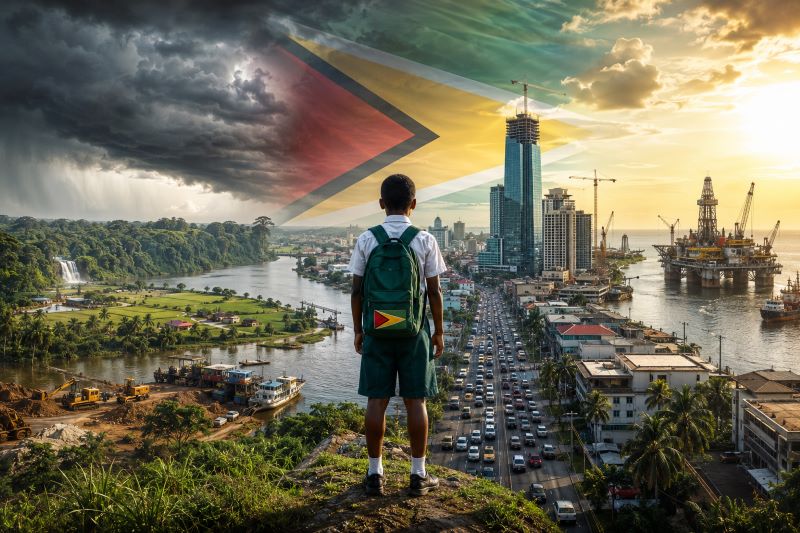
Few countries have undergone a transformation as dramatic as Guyana’s. In just over a decade, it has moved from being one of the poorest economies in South America to one of the fastest-growing in the world, driven by the discovery of vast offshore oil reserves. Economic indicators now dominate international headlines. Gross domestic product continues to expand at extraordinary rates. New highways are under construction. Hotels are rising across Georgetown. International investors arrive almost daily.
Yet behind these impressive numbers lies a far more complex national story.
The true measure of a country’s success has never been the size of its economy. It is measured by whether ordinary citizens experience greater security, fairness, opportunity, and confidence that tomorrow will be better than today.
That is the question now facing Guyana.
A Nation Rich Long Before Oil
Long before oil transformed its fortunes, Guyana was already a country of remarkable natural wealth.
Gold, diamonds, bauxite, timber, fertile agricultural land, abundant freshwater resources, fisheries, and vast forests have supported generations. Equally valuable has been its human capital. Guyanese professionals have distinguished themselves globally in medicine, engineering, finance, academia, aviation, science, and technology.
Ironically, one of Guyana’s largest exports over the past sixty years has been its people.
Beginning with the political turmoil of the early 1960s and continuing through decades of economic hardship, instability, crime, and limited opportunity, hundreds of thousands sought better lives abroad. Each wave of migration represented not only families leaving home, but also the loss of knowledge, entrepreneurship, and leadership.
Guyana’s greatest challenge has never been a lack of resources.
It has been the inability to organize those resources around a coherent, long-term national vision.
The Burden of History
Guyana’s modern political history is deeply marked by periods of violence, allegations of corruption, economic decline, organized crime, extrajudicial killings, and persistent ethnic polarization.
Every administration inherited difficult circumstances.
Every administration also made choices that shaped the nation’s path.
Too often, public institutions have appeared weaker than political interests. Citizens have repeatedly questioned whether accountability is applied equally across society. Confidence erodes when justice appears selective.
Without trust in institutions, even rapid economic growth cannot produce lasting stability.
From Colonial Rule to Political Privilege
One of the enduring ironies of Guyana’s political evolution is that many leaders who once condemned colonial privilege have themselves become beneficiaries of extensive state-funded advantages.
Official residences, security details, transportation, domestic staff, overseas travel, utilities, and communications have become normalized features of political office.
Meanwhile, many ordinary Guyanese continue to face daily challenges that have changed little over generations.
Parents struggle to afford school supplies.
Children travel long distances to attend school.
Communities still contend with inadequate drainage, healthcare, and infrastructure—despite unprecedented national revenues.
The contrast between public hardship and visible political privilege inevitably raises questions about national priorities.
Oil Changed the Economy. Has It Changed Governance?
The arrival of oil revenues created extraordinary opportunity.
It also introduced serious risk.
History shows that countries rich in natural resources often encounter the “resource curse,” where rapid wealth accumulation weakens institutions, fuels corruption, increases inequality, and concentrates power.
Whether Guyana will be an exception remains uncertain.
Rising property values, construction costs, rental prices, and consumer goods have placed new pressure on households whose incomes have not kept pace with inflation. While some segments of society have benefited significantly, many families continue to experience a declining sense of economic security despite the country’s rapid growth.
The challenge is no longer generating national income.
It is ensuring that prosperity is widely shared through transparent institutions, effective public services, quality education, reliable healthcare, modern infrastructure, and equal opportunity.
Corruption and Everyday Life
Corruption is rarely confined to headline scandals.
Its most damaging effects are often quiet and routine.
When citizens believe that permits, licenses, contracts, employment, or even basic services require unofficial payments or political connections, trust begins to erode. Entrepreneurs become discouraged. Investors hesitate. Young professionals look elsewhere.
Over time, corruption shifts from isolated behavior to accepted practice.
No country prospers under those conditions.
The Pressure of Rapid Change
Guyana now faces another challenge that receives less attention: rapid population change.
International workers, investors, contractors, and migrants are entering the country in unprecedented numbers as opportunities expand.
Migration can strengthen societies. But rapid growth also places pressure on housing, transportation, healthcare, education, policing, and public administration, especially when planning lags behind development.
Managing growth requires more than revenue.
It requires competent, forward-looking governance.
Beyond Politics
Too much of Guyana’s national conversation remains confined to political loyalty.
Supporters defend. Opponents condemn.
Meanwhile, the most important questions remain unresolved:
How should oil wealth be managed over the next fifty years?
How can institutions become stronger than political parties?
How can education prepare young Guyanese for a future shaped by technology, artificial intelligence, and global competition?
How can transparency replace corruption in practice, not just rhetoric?
How can national unity overcome division?
These are the questions that will define the country long after current political figures have left the stage.
The Generation That Matters Most
Ultimately, the greatest responsibility may not rest with today’s leaders, but with today’s children.
They will inherit either strong institutions capable of sustaining prosperity, or systems weakened by corruption, division, and short-term thinking.
Oil revenues will decline. Natural resources will diminish.
Only strong institutions, an educated population, and accountable governance can sustain prosperity across generations.
History offers many examples of nations that became wealthy.
Far fewer became truly developed.
Guyana now faces a rare and defining choice.
Its future will depend less on the quantity of oil beneath the Atlantic than on the quality of leadership above it.
The defining question is no longer whether Guyana will become rich.
It is whether it will become a nation where justice, opportunity, accountability, and prosperity belong to every citizen.
That answer is still unwritten.