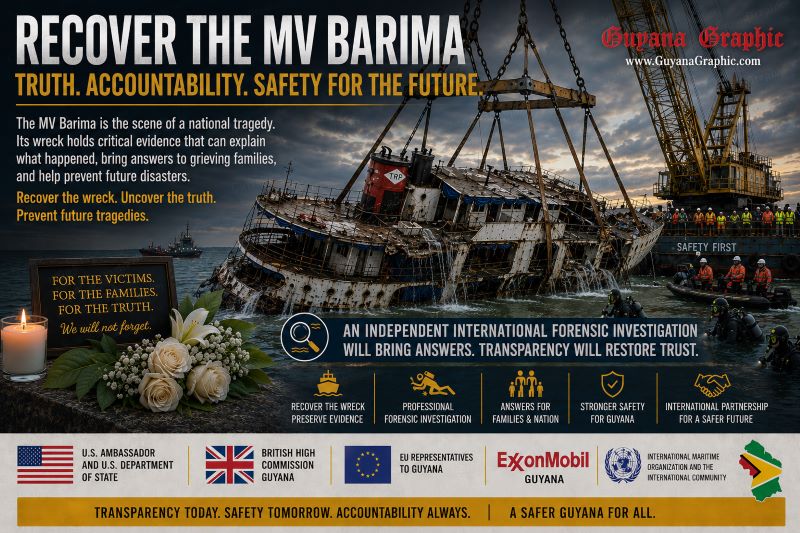
An appeal to the international community to support an independent recovery and forensic investigation into one of Guyana’s worst maritime disasters.
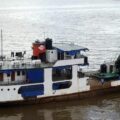
The announcement by Prime Minister Brigadier (Ret’d) Mark Phillips that the Government of Guyana does not intend to recover the MV Barima should concern every citizen of Guyana and every member of the international community with an interest in transparency, public safety, and accountability.
The MV Barima is no longer simply a sunken vessel. It is the scene of a national tragedy.
It may also be the final resting place of victims whose families deserve every reasonable effort to recover their loved ones. Beyond that profound humanitarian obligation, the wreck itself almost certainly contains critical physical evidence capable of explaining why this disaster occurred.
Every major aviation, maritime, rail, and industrial disaster teaches the same lesson. The wreckage tells a story.
That story cannot be fully understood from assumptions, eyewitness accounts, or political statements alone.
The vessel may preserve evidence relating to structural failure, stability, loading practices, cargo distribution, mechanical condition, flooding progression, emergency response, navigation equipment, safety procedures, communications, or other factors that can only be evaluated through a professional forensic examination.
Without recovering the vessel, Guyana risks replacing evidence with speculation.
- Families deserve facts.
- The nation deserves facts.
- Future generations deserve facts.
This is precisely why countries with mature transportation safety systems invest enormous resources recovering aircraft from oceans, ships from deep waters, and trains from accident scenes. The objective is not merely to assign blame. The objective is to understand exactly what happened so that lives can be saved in the future.
Guyana now stands at an important crossroads.
The country is experiencing unprecedented economic growth driven largely by its offshore petroleum industry. That growth brings increased maritime activity, larger industrial operations, more complex logistics, and significantly greater public safety responsibilities.
As Guyana modernizes, its accident investigation capability must modernize with it.
The recovery of the MV Barima should therefore become more than an investigation into one tragedy. It should become the foundation for establishing international best practices for future emergency response and accident investigation.
Guyana should invite internationally respected maritime accident investigators to participate alongside local authorities in a fully transparent inquiry. Their independence would strengthen public confidence while providing access to specialized expertise, equipment, and investigative techniques that may not currently exist within Guyana.
We therefore respectfully appeal to the United States Ambassador, the British High Commissioner, representatives of the European Union, the United States Department of State, the International Maritime Organization, and other democratic partners with longstanding commitments to safety and good governance to encourage the Government of Guyana to reconsider its decision.
Their support need not interfere with Guyana’s sovereignty. Rather, it would reinforce universal principles that every nation benefits from.
- Transparency.
- Scientific investigation.
- Professional accountability.
- Protection of human life.
We also appeal to ExxonMobil Guyana and every major international company operating within Guyana.
These organizations have invested billions of dollars in Guyana’s future. They possess extensive experience managing complex industrial risks and responding to major emergencies around the world. Corporate citizenship should extend beyond community projects and sponsorships.
Supporting improvements in national emergency preparedness, maritime rescue capability, forensic investigation capacity, and disaster response planning would leave a lasting legacy that protects every citizen, every visitor, and every worker operating in Guyana.
The lessons learned from recovering the MV Barima could help establish:
- A permanent national marine accident investigation capability.
- International standards for maritime disaster response.
- Modern underwater search and recovery capacity.
- Improved passenger vessel inspection and certification procedures.
- Enhanced cargo and passenger accountability systems.
- Better emergency communications.
- National rapid deployment rescue resources.
- Stronger coordination between government agencies and private industry.
- Regional mutual assistance agreements for major emergencies.
- Comprehensive recommendations designed to prevent similar tragedies.
Every developed transportation system has evolved because difficult questions were asked after terrible events. Those questions were answered through evidence. Evidence begins with recovering the wreckage.
If the MV Barima remains on the seabed, valuable forensic evidence may deteriorate with time. Future investigators may lose opportunities to determine precisely what occurred, leaving unanswered questions for families and limiting the ability to implement evidence-based safety improvements.
History will judge not only the tragedy itself, but how the nation responded to it. Recovering the MV Barima is about more than a vessel. It is about respecting those who perished. It is about providing answers to grieving families. It is about restoring public confidence. It is about building a safer Guyana. Most importantly, it is about ensuring that every lesson this tragedy has to teach is learned before another life is lost.
A nation blessed with extraordinary natural wealth should also aspire to world-class standards of safety, accountability, and transparency. Recovering the MV Barima through an independent international forensic investigation would be an important step toward achieving that goal.
Ian G. Hall
#USEmbassyGuyana, #UKinGuyana, #EUinGuyana, #ExxonMobilGuyana, #ExxonMobil