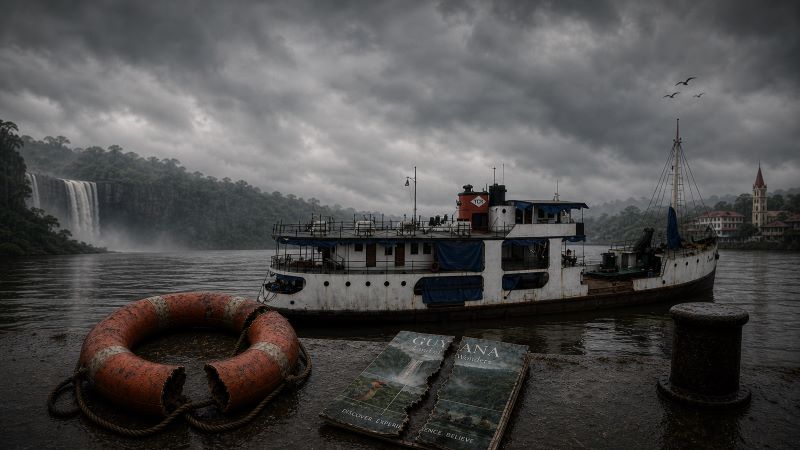
For years, Guyana has invested millions of dollars promoting itself as one of South America’s newest tourism destinations. International campaigns have showcased Kaieteur Falls, the Rupununi, pristine rainforests, Indigenous communities, sport fishing, birdwatching, eco-lodges, and the country’s remarkable biodiversity. The discovery of oil has further elevated Guyana’s international profile, creating expectations that modern infrastructure and improved public services would accompany unprecedented national wealth.
Then came the sinking of the MV Barima.
The tragedy, one of the worst maritime disasters in Guyana’s modern history, has done more than claim innocent lives. It has raised uncomfortable questions about the country’s readiness to welcome visitors, its regulatory oversight, and whether the benefits of billions of United States dollars in oil revenues are translating into safer public infrastructure and more effective governance. Authorities have launched an independent investigation into possible overloading, operational failures, crew conduct, and institutional shortcomings.
The issue facing Guyana today is not tourism promotion. It is credibility.
Tourism Is Built on Confidence
Tourists do not simply purchase airline tickets and hotel reservations. They purchase confidence.
They assume that roads are reasonably safe, aircraft are properly maintained, ferries operate under strict regulations, emergency services are capable of responding when disaster strikes, and government institutions enforce the rules equally.
When those assumptions are challenged, visitor confidence begins to erode.
The MV Barima tragedy has placed Guyana’s transportation systems under an international spotlight. Global media coverage has focused on reports of discrepancies in the passenger manifest, allegations of overloading, questions surrounding crew conduct, and concerns about regulatory oversight.
For potential visitors unfamiliar with Guyana, these stories can become their first impression of the country.
Oil Wealth Creates Higher Expectations
Before becoming a major oil producer, Guyana’s infrastructure challenges were often viewed through the lens of limited financial resources.
That explanation has become increasingly difficult to sustain.
With billions of US dollars expected to flow into the country’s economy over the coming decades, international observers naturally expect improvements in transportation, emergency response, public safety, regulatory enforcement, and institutional capacity.
The world understands that accidents happen.
What it scrutinizes is whether those accidents were preventable.
Questions naturally arise.
Has maritime regulation kept pace with economic growth?
Are inspections rigorous and independent?
Have aging transportation assets been replaced before becoming liabilities?
Have oil revenues been invested strategically in systems that protect citizens and visitors alike?
These are not political questions. They are governance questions.
The Reputation of a Destination
Tourism brands are fragile.
Years of careful marketing can be undermined by repeated images of tragedy, poor crisis management, or institutional failures.
Countries such as Costa Rica, Botswana, and New Zealand have demonstrated that safety, environmental stewardship, and competent governance can become integral parts of a national tourism brand.
Conversely, destinations associated with transportation failures, weak regulation, or ineffective emergency management often face higher insurance costs, greater scrutiny from tour operators, and increased caution among independent travelers.
Guyana cannot afford to allow its international image to become defined by preventable failures instead of its extraordinary natural assets.
Investors Are Watching Too
The implications extend beyond tourism.
International investors distinguish between commercial opportunity and institutional capability.
Guyana’s petroleum reserves remain among the world’s most attractive investment opportunities.
However, investors also evaluate governance.
They examine whether regulations are enforced consistently, whether public institutions function effectively, whether investigations are independent, and whether governments respond to failures with meaningful reforms rather than public relations exercises.
Strong governance lowers risk.
Weak governance increases the cost of doing business.
Leadership Will Be Judged by the Response
The Government has established an independent commission comprising regional legal and maritime experts to investigate the disaster, an important step toward ensuring public confidence in the findings.
That investigation must now be transparent, thorough, and fearless.
If evidence demonstrates negligence, accountability must follow.
If systemic failures are identified, reforms must be implemented.
If infrastructure requires modernization, investment should become an urgent national priority rather than another promise.
The greatest damage to Guyana’s reputation would not come from the tragedy itself.
It would come from any perception that the lessons of the MV Barima were ignored.
A Defining Moment
The MV Barima disaster presents Guyana with a defining choice.
The nation can emerge stronger by demonstrating that every recommendation is implemented, every institution strengthened, and every preventable weakness corrected.
Or it can reinforce international concerns that unprecedented oil wealth has not yet translated into stronger governance, safer public services, and better protection for citizens and visitors.
Tourism campaigns can purchase advertising.
They cannot purchase trust.
Trust is earned through competent leadership, transparent institutions, public accountability, and the consistent protection of human life.
The world will not judge Guyana solely by the tragedy of the MV Barima.
It will judge the country by what Guyana chooses to do next.