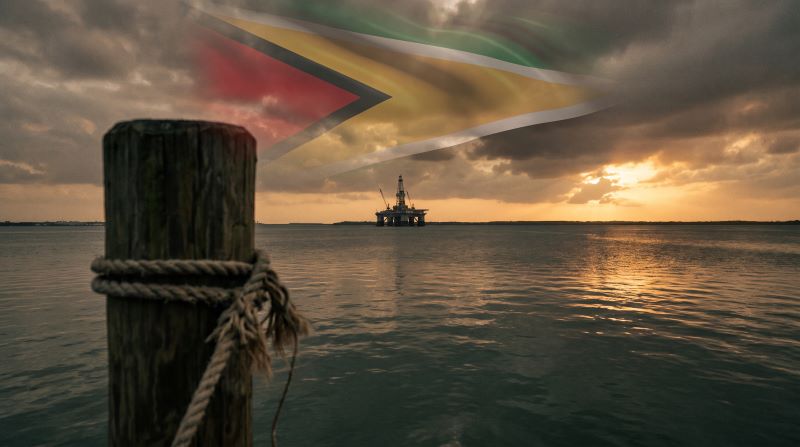
Civil society has every right to ask Exxon to pause its good-governance funding until Guyana’s institutions show they deserve the association
Every year, ExxonMobil Guyana publicizes the millions it channels into “good governance,” civic education, youth leadership, and institution-building programs across the country. The company has reported spending in the hundreds of millions of Guyana dollars on such community investments, alongside its broader social spending, which it says topped GY$8.6 billion in 2024 alone (Guyana Chronicle). It is a message built for glossy annual reports and corporate citizenship award ceremonies (LinkedIn/OilNOW). It is also, increasingly, a message that rings hollow against the lived reality of the country Exxon operates in.
Civil society groups asking whether Exxon should suspend its good-governance sponsorships are not being unreasonable. They are asking a company that markets itself as a partner in strengthening Guyanese institutions to explain how that partnership squares with a state that, this year alone, has been unable to protect its citizens from preventable disaster, has met peaceful dissent with detention, and has left serious questions about corruption and cover-up unresolved.
A ferry that should never have sailed
On the night of July 19, the MV Barima, an 87-year-old government ferry, capsized off the Essequibo coast en route from Georgetown to Port Kaituma. Officials initially said 133 people were aboard, matching the manifest. Within days, the government admitted the real number was likely closer to 179 (AP News). By July 23, roughly 53 bodies had been recovered, 76 people were confirmed rescued, and dozens remained missing, in what officials have called the country’s worst maritime disaster in decades (Al Jazeera; Wikipedia/MV Barima). The captain and a crew member were arrested after testing positive for narcotics. The manifest, it turns out, was fiction (Reuters; New York Times).
This tragedy did not happen in a vacuum. It happened on a route the state had known for years was served by an aging vessel, in a country that has poured unprecedented oil revenue into its treasury since 2019 without meaningfully modernizing the ferry service that rural, Indigenous, and mining communities in Region One and Region Two depend on for their lives. Two new ferries were meant to replace vessels like the Barima. Their absence from that Saturday night crossing is not an abstraction, it is the difference between a manifest and a body count. A state that cannot get safe transportation right, even while collecting billions in petroleum revenue, is not a credible graduate of a “good governance” program.
And even in the disaster’s immediate aftermath, the instinct toward control over transparency resurfaced: opposition Member of Parliament Sherod Duncan was detained by police while visiting grieving families in Charity, Region Two, and had his drone, camera, and other equipment confiscated, with no official explanation offered (YouTube/reporting on the incident). A nation in mourning does not need parliamentarians obstructed from documenting a national tragedy.
A pattern, not an anomaly
The ferry disaster is the most acute recent failure, but it is not isolated. Earlier this year, flooding across Regions Four, Five, and Six displaced families and destroyed property, with opposition parties charging that years of warnings about compromised drainage infrastructure along major road-expansion corridors were “brushed aside, ignored, and fell on deaf ears” (Kaieteur News). Whatever one’s politics, the pattern is the same one repeated at sea in July: infrastructure warnings ignored until disaster forces the issue.
The case of 11-year-old Adrianna Younge, who disappeared at a hotel pool in April 2025 and was found dead the next morning, remains a wound the state has never fully closed. Multiple independent autopsies concluded she drowned, and a Canadian investigator found no evidence of foul play (Jamaica Observer; Spectrum Magazine). But the initial claim that the hotel’s CCTV was non-functional, later contradicted by outside footage, the hours-long delay before her body was found in a pool that had reportedly already been searched, and the government’s continued silence on the family’s request for an independent probe have left many Guyanese unconvinced that the full truth has been told (News Room Guyana; Kaieteur News). Whether or not one accepts the drowning conclusion, the state’s handling of transparency around the case set a troubling precedent, and the protests it provoked were met with mass arrests, over 100 people detained within 24 hours, according to police’s own count (News Room Guyana).
Corruption allegations swirling around senior figures, including Vice President Bharrat Jagdeo and Minister Susan Rodrigues, remain publicly unresolved. Rodrigues has faced calls to resign over asset-disclosure questions that President Irfaan Ali ultimately accepted her explanation for, rather than referring to independent scrutiny (Guyana Standard; Demerara Waves). Jagdeo has faced bribery allegations dating back years, which he has denied and pursued defamation action over, rather than submitting to an independent commission of inquiry that opposition parties have repeatedly demanded (Kaieteur News). None of this constitutes proof of guilt. It does constitute a pattern of a political class that investigates itself, on its own terms, on its own timeline, and rarely arrives at consequences.
Even a moment meant to project national pride, the flag-raising ceremony at Fort Island for Guyana’s 60th independence anniversary, descended into disorganized chaos serious enough that the U.S. Ambassador herself was reportedly caught in a crush of attendees scrambling for transport, a scene this publication has already flagged as a genuine security vulnerability, not a minor logistics hiccup (Guyana Graphic). If the state cannot secure a ceremonial event attended by a foreign head of mission, what confidence should citizens have in its capacity to secure a ferry route, a flood-prone town, or a police investigation?
The question civil society is right to ask
None of this is Exxon’s fault. Exxon did not sink the Barima, flood Regions Four and Five, or arrest an opposition MP. But Exxon has chosen, publicly and repeatedly, to attach its brand to “good governance” as a philanthropic pillar in Guyana, precisely because good governance is the thing Guyana’s oil wealth was supposed to buy and hasn’t. That positioning carries an implicit endorsement: that the state receiving Exxon’s revenue, and the institutions Exxon funds alongside it, are moving toward the transparency and accountability the company claims to champion.
When search-and-rescue vessels contracted by ExxonMobil and its affiliates were mobilized to help locate the Barima’s wreckage (Reuters/Fidelity), it was a genuine and welcome contribution. But operational assistance in a crisis is not the same as governance sponsorship, and it should not be allowed to blur the distinction. Civil society groups are not asking Exxon to abandon Guyana or withdraw investment. They are asking a legitimate and answerable question: what is the value of funding “good governance” programming in a country whose government has, in the span of little more than a year, mismanaged a fatal maritime disaster, failed to secure basic flood infrastructure, met grief and protest with arrests rather than accountability, and left credible corruption allegations against senior officials to linger without independent resolution?
Suspending or conditioning that funding, publicly and transparently, until the state demonstrates concrete governance reforms, an independent maritime disaster inquiry with real teeth, a transparent accounting of flood-control failures, protection for peaceful assembly, and genuine follow-through on corruption allegations, would not be interference in Guyana’s sovereignty. It would be exactly what any responsible corporate citizen should do when the institutions it funds to demonstrate governance keep failing the governance test in public, in real time, with real casualties. Civil society is not asking Exxon to punish Guyana. It is asking Exxon to stop lending its name to the appearance of good governance while the substance of it remains, disaster after disaster, unmet.
This is an editorial reflecting the position of the Guyana Graphic editorial board. Corruption allegations referenced against named officials remain unresolved matters of public record and are not presented as findings of fact. Guyana Graphic invites response from ExxonMobil Guyana, the Government of Guyana, and named officials.
Email: info@GuyanaGraphic.com